I’ve always had strong intuition. Not in a psychic sense—no visions or predictions—but a steady internal awareness that tends to surface before I have proof.
I’ve sensed when something was off before it fully revealed itself. I’ve walked into rooms and immediately felt the emotional temperature. At one job, that intuition became unexpectedly practical: after interviews, candidates would be walked past me and I’d be asked whether I thought they would work out. I couldn’t explain it in concrete terms. It wasn’t a checklist or a theory—just a feeling. And more often than not, that feeling turned out to be right.
For a long time, I didn’t know what to do with that intuition. I trusted it, but I didn’t have a framework for understanding it or refining it.
Then tarot started showing up everywhere.
Not all at once, and not dramatically—just persistently. Online shopping suggestions. A reference in a TV show. A scene in a movie. Random posts drifting through my social feeds. Eventually, it stopped feeling like coincidence and started feeling like curiosity asking to be answered.
I mentioned it to my husband, fully expecting him to laugh when I said I wanted to buy a tarot deck. He didn’t. He was supportive, calm, and encouraging—exactly the response I needed. So I bought a deck. And then I did what I always do when something genuinely interests me: I started reading.
Learning Tarot as a Language
Two books became foundational early on.
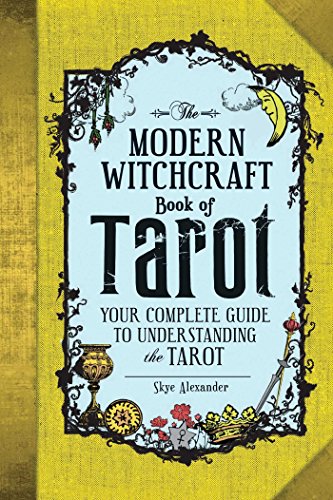
The Modern Witchcraft Book of Tarot: Your Complete Guide to Understanding the Tarot by Skye Alexander gave me structure. It introduced the symbolism, the suits, the archetypes, and the underlying system in a way that felt accessible rather than rigid. It helped me understand tarot as a language with rules and patterns—not just intuition floating in space.
The Modern Witchcraft Book of Tarot: Your Complete Guide to Understanding the Tarot (Modern Witchcraft Magic, Spells, Rituals)
Featuring twelve of the most popular spreads and easy-to-follow explanations of how tarot readings can be interpreted.
At the same time, The One Card Tarot Journal by Maria Sofia Marmanides slowed everything down. Instead of rushing into spreads or looking for answers, it encouraged sitting with a single card. Observing it. Writing about it. Letting meaning unfold over time rather than forcing conclusions.
The One Card Tarot Journal: 150 Prompts for Single Card Tarot Wisdom
With questions on everything from relationships and careers to personal goal setting and transformation, The One Card Tarot Journal allows you to explore every aspect of your life.

That balance mattered more than I realized at first.
One book taught me how tarot works.
The other taught me how to listen.
From Intuition to Practice
In the beginning, my readings were almost entirely intuitive—focused on imagery, emotion, and immediate reaction. Over time, something shifted. I began to notice how cards interacted with each other. How placement altered meaning. How repetition, absence, and direction carried just as much weight as symbolism itself.
Early on, I read cards in isolation.
Now, I read spreads as conversations.
That shift didn’t happen quickly. It came from daily practice. I tarot journal every day—not to predict outcomes, but to understand my own thinking, reactions, and emotional patterns. Tarot became a grounding tool. It helped me slow down, temper emotional responses, and align my inner world when things felt scattered or overwhelming.
It’s reflective. It’s clarifying. It’s steady.
How My Readings Evolved
As my understanding deepened, my readings became quieter and more restrained. Less about dramatic interpretations, more about coherence and context. Tarot taught me patience. It taught me how to sit with uncertainty instead of rushing toward resolution.
That evolution mirrors how I approach books, games, and stories more broadly. I’ve always been drawn to systems—narratives, mechanics, symbolism—and tarot fits naturally alongside that way of thinking. It isn’t separate from the rest of LILLIDIGEST; it’s a parallel pillar.
I even wrote about board games that play like reading tarot long before The Mystic Digest existed. In hindsight, the connection feels obvious.
What The Mystic Digest Is
The Mystic Digest is where tarot, research, and interpretation meet.
All tarot readings are part of the paid subscription. Subscribers receive four in-depth readings each month, often more when current events or breaking news call for reflection. These readings explore historical events, unsolved mysteries, cultural moments, and well-known figures—not as predictions, but as symbolic and interpretative examinations.
Each reading blends factual context with tarot symbolism. The history is real. The cards are interpretive. Together, they create space for inquiry rather than answers handed down from on high.
This isn’t fast tarot. It isn’t tidy. It isn’t about certainty.
It’s about perspective.
Elegant reverse design―The cards feature a matching pattern on the backs so your deck will be beautiful and cohesive on both sides.

Why I Chose to Share This Now
I didn’t rush into sharing this part of my life. Tarot was something I practiced privately for a while before it ever became public. It grew quietly, through study and repetition, before it became something I felt comfortable sharing with others.
This post is the doorway.
The Mystic Digest is the ongoing conversation—for readers who are curious about tarot as a language, a reflective tool, and a way of engaging with stories, history, and uncertainty without performance or spectacle.
I didn’t set out to become a tarot reader. I set out to understand myself better.
Along the way, tarot gave my intuition structure. It gave it vocabulary.
And once you learn a language, you don’t stop hearing it.
If this way of thinking about tarot resonates with you, The Mystic Digest is where that work continues. All readings live inside the subscription and explore history, mysteries, cultural moments, and well-known figures through a blend of factual context and tarot symbolism. New readings are published weekly on Tuesday mornings at 10:00 a.m., with additional pieces added when events call for reflection rather than immediacy.
There’s no rush and no obligation—just an open door for readers who want to sit with the cards a little longer.